Summary
- Digital transformation fails when plans are too ambitious or misaligned to how teams actually work
- Start with CRM as your foundation, it connects sales, operations, and service into one source of truth
- Follow four phases over 12-18 months: Clarity & Assessment, Foundation Building, Integration & Intelligence, Scale & Optimization
- Define success metrics upfront (quote response time, forecast accuracy, adoption rates)
- Leadership visibility and commitment is non-negotiable for adoption
- Expect real payback within 12-18 months with proper implementation and change management
Manufacturing operations leaders are at a crossroads. Budget planning conversations are happening now. The question isn’t whether digital transformation matters. It’s where to start and how to avoid another expensive software investment that fails.
Some manufacturers launch ambitious, all-encompassing initiatives that drown in complexity. Others take a deliberate approach: identify the biggest bottleneck, build in phases, measure results. The difference between success and stall is clarity.
The most successful manufacturers started with CRM as the foundation. This guide walks you through building a digital transformation roadmap that actually works.
Why Your Digital Transformation Needs a Roadmap (Not a Wish List)
Before diving into construction, let’s be clear about the challenge. Digital transformation fails when the plan is either too ambitious or poorly aligned to how people actually work.
Here’s what we see most often:
- The Scope Creep Problem. Leadership wants AI, automation, cloud migration, ERP upgrades, and real-time analytics all at once. The result is a bloated roadmap that overwhelms your team and stretches budgets beyond reason.
- The Adoption Gap. Technology gets implemented, but teams keep using spreadsheets and workarounds because the system doesn’t match their actual workflows.
- The Visibility Void. Finance asks “What will this cost?” Operations asks “When do we see results?” Nobody has a clear answer because success metrics were never defined upfront.
A proper digital transformation roadmap solves these problems by forcing difficult conversations early:
- What’s broken?
- What matters most?
- Which initiatives drive the biggest business impact per dollar invested?
The Foundation: Start Where Your Biggest Pain Points Are
Most manufacturing operations leaders are juggling one or more of these challenges. Pipeline data is fragmented across spreadsheets, email, and tribal knowledge. Quoting is slow and manual. Demand forecasts don’t align with production capacity. Field service is reactive instead of proactive.
These aren’t technology problems. They’re visibility problems.
A well-configured CRM becomes the nervous system that connects sales, operations, and service. It’s what transforms fragmented data into actionable intelligence. But here’s the catch: CRM only works if it actually aligns with how your business operates. Generic implementations fail because they impose a process model that doesn’t fit manufacturing reality: long sales cycles, engineering reviews, capacity constraints, and partner networks.
The manufacturing digital transformation roadmap you’re about to build fixes that misalignment.
Your Manufacturing Digital Transformation Roadmap: Four Phases Over 12 Months
A realistic manufacturing digital transformation roadmap spans 12-18 months and moves through four distinct phases. This timeline lets you build momentum, validate assumptions, and adjust without overwhelming your team.
Phase 1: Clarity & Assessment (Months 1-2)
Understand what you have and what’s broken. Map your current systems and where teams waste time on manual work. Define success metrics upfront: quote response time, forecast accuracy, sales cycle length, data quality, and adoption rates. Survey your team about their biggest frustrations.
Phase 2: Foundation Building—CRM as Your North Star (Months 3-6)
Design your CRM around actual manufacturing workflows. If you’re rescuing an underperforming instance, assess the real issues: duplicate records, inconsistent data, misaligned processes, limited ERP integration, and flatlined adoption.
Manufacturing sales cycles need multi-stage quoting, complex approvals, long touchpoints, ERP integration, and partner management. Create role-specific training. Build continuous learning through monthly power user sessions and peer coaching. This is where strategic consulting makes the real difference in driving adoption.
Before moving forward, get an honest picture of what’s holding you back. Most manufacturers discover their manufacturing digital transformation roadmap needs to address something unexpected: data quality issues, workflows that don’t fit Salesforce, or adoption challenges tied to generational differences.
The ROI Worksheet below walks you through the most common efficiency blockers. It takes 10 minutes and shows you where your biggest opportunities actually are.
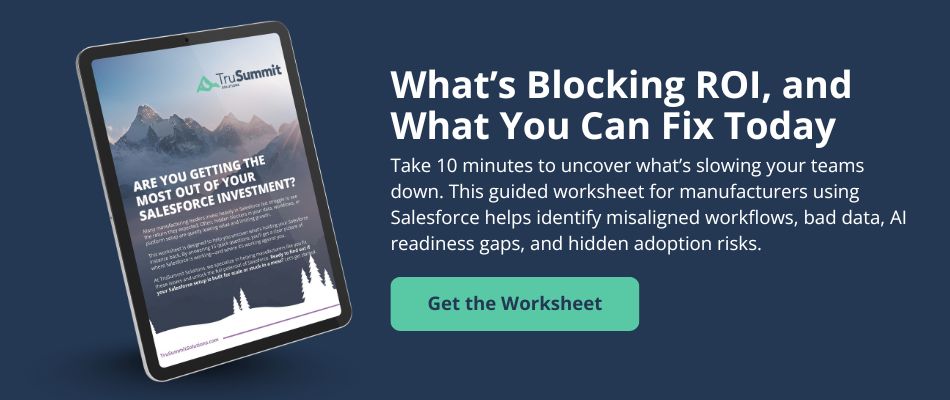
Once completed, you’ll know which phases matter most for your situation. Some roadmaps need more time in Phase 1. Others accelerate through Phase 2. The roadmap that works is the one that matches your reality.
Phase 3: Integration & Intelligence (Months 7-10)
Once your CRM foundation is solid, connect it to the systems that power your business. Link your CRM to ERP for real-time inventory and costing. Connect opportunities to production capacity planning. Establish data governance rules and assign stewards. Build dashboards showing forecast accuracy, pipeline health, and customer profitability.
Phase 4: Scale & Optimization (Months 11-18 and Beyond)
Expand to adjacent functions like service optimization or partner management. Measure actual outcomes against metrics you defined in Phase 1. Document improvements and communicate wins to your leadership team.
The Budget Conversation: Realistic Investment
Your finance team will ask two questions: “How much is this going to cost?” and “When do we see payback?”
The answer depends on your organization’s size, current system state, and scope. CRM implementation costs vary significantly based on complexity, customization needs, and whether you’re starting fresh or optimizing an existing instance. Integration work, data migration, training, and change management all factor into the total investment.
Most improvements appear between months 5-8 as your team adopts the system and data quality improves. Real payback depends on your specific situation and how aggressively you address adoption and data governance.
To dive deeper into ROI measurement and frameworks specific to manufacturing, check out How to Calculate (and Maximize) Salesforce ROI in Manufacturing.
The Leadership Commitment Question
Digital transformation requires visible, consistent leadership commitment. This isn’t about mandates. It’s about executives actively using the system daily, tying CRM adoption to performance reviews, and communicating why this matters to the business strategy.
When your team sees operations using forecast data from CRM to drive production planning, when they see sales compensation tied to pipeline accuracy, when they see leadership actually entering their own activity data—adoption happens naturally.
Conversely, when leadership treats CRM as a “sales tool” or an “IT project,” adoption stalls. Teams sense the signal that it doesn’t matter as much as leadership said it did.
Your Manufacturing Digital Transformation Roadmap: The Checklist
As you plan your roadmap, sense-check these key areas. Use this as a planning tool to identify gaps and ensure nothing falls through the cracks.
Discovery & Clarity
- Have you mapped and prioritized your pain points?
- Do you have a clear understanding of your current systems and manual processes?
- Are success metrics defined upfront (quote response time, forecast accuracy, adoption rates)?
- Have you surveyed your team about their biggest frustrations?
- Is leadership aligned on what success looks like?
CRM Foundation
- Is your system designed specifically for manufacturing workflows, not just generic B2B sales?
- Do you have role-specific training plans developed for sales, operations, and service teams?
- Are data quality standards established and documented?
- Have you identified quick wins to build momentum early? Is there a plan for continuous learning beyond day-one training?
Integration & Intelligence
- Is your ERP-to-CRM integration roadmap clearly defined?
- Do you have a data governance framework in place with assigned data stewards?
- Are KPI dashboards and reporting structures designed?
- Have you planned how to connect opportunities to production capacity?
- Are success metrics tied to business outcomes you actually care about?
Scale & Sustain
- Is your change management strategy documented and owned by leadership?
- Have you allocated ongoing training budget for year 1 and beyond?
- Is ROI measurement planned with a cadence for reviews?
- Are you prepared to expand to adjacent functions like service optimization or partner management?
- Does leadership have a plan to visibly champion the system?
Next Steps: Start With Clarity
Digital transformation doesn’t need to be scary or expensive if you approach it strategically. The key is understanding where you are, where you want to go, and having a realistic plan to get there.
If your manufacturing organization is wrestling with forecast accuracy, sales visibility, or operational alignment, now is the time to build your roadmap. Budget decisions are being made now. Forward-thinking leaders are securing resources for initiatives that will actually move the needle.
The difference between a transformation that sticks and one that stalls is clarity in your plan.
TruSummit can help you assess your current state, identify quick wins, and design a phased approach tailored to your manufacturing operation. Schedule a conversation with one of our senior consultants about building your roadmap.
Featured Articles
5 Reasons CRM Adoption Fails in Manufacturing – and How to Fix It
Manufacturing companies invest millions in CRM systems, and while 86% of manufacturing companies now use a CRM system, over 70%…
The Real ROI of Salesforce for Mid-Market Manufacturers: What the Numbers Actually Say
The Real ROI of Salesforce for Mid-Market Manufacturers: What the Numbers Actually Say Key Takeaways Organizations in a Forrester composite…
The Salesforce Technical Debt Playbook: A Quarterly Cleanup Framework for Manufacturing Orgs
Key Takeaways: Salesforce technical debt slows releases, increases maintenance costs, and threatens data quality for manufacturing operations. A quarterly audit…